





ORGANS OF PARIS © 2026 Vincent Hildebrandt HOME ALL ORGANS



This church was built in a neo-classical style in 1841-
1844 by the architect Paul-Eugène Lequeux (1806-
1873). The choir was enlarged in 1930-1933 by the
architect Dubos.
E6
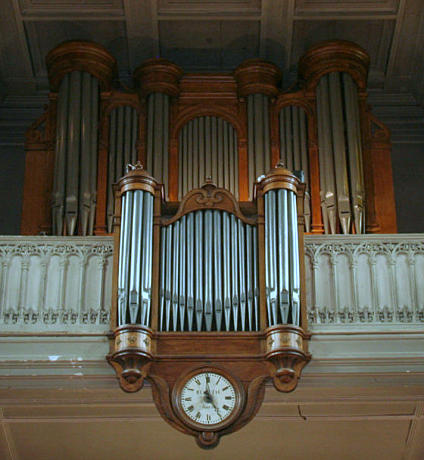
The organ was built by Suret around 1860, having two
keyboards and pedal (25 stops)
Rebuilt by Mutin-Cavaillé-Coll at the very beginning of the 20th
century.
1942
Michel-Merklin and Kuhn electrified the transmission of notes
and applied the pneumatic system to that of the stops; in
addition, the Récit was removed and placed on one side of the
Great Organ (to the right when looking at the organ). A Positive
keyboard was provided for at the console but was not installed
due to lack of credits, as was a Flute 16.
1983
Gonzalez replaced with electric motors.
1998-2002
A restoration and enlargement were carried out by Dargassies:
•
the two badly damaged windchests of the Récit were
replaced by a single new one
•
a Plein-Jeu and a Voix Humaine were added to the Récit
•
the Récit (on the right when facing the instrument) is now
fitted with two sets of swell shades, controlled separately
from the front and the side
•
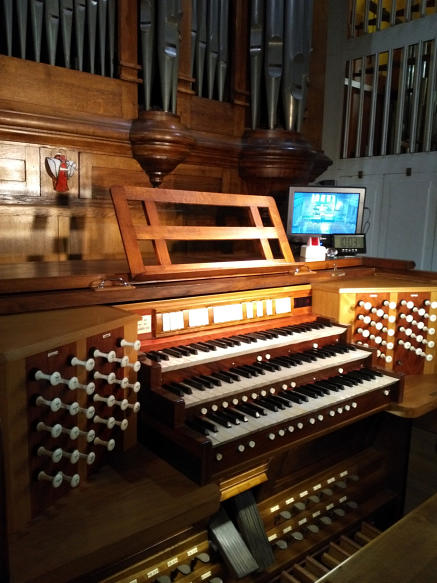
the third “Solo” keyboard was installed (on the left when
facing the instrument), in place of the Positif planned by
Merklin & Kuhn but never built, featuring in particular a
striking Tuba Mirabilis 16, 8 and 4 (with horizontal sound
projection); it was also given a Grand Cornet, answering the
divided Cornet on the Récit, as well as more strongly voiced
foundation stops (Flute Majeure) and an 8′ Clarinet with an
extension to a 16′ Douçaine
•
the existing windchests were refurbished and the organ
cases fully restored (Grand Orgue and Récit) and newly
built (Solo)
•
the electric transmissions were replaced by a solid-state
system
•
adjustable combinations (512) were added
•
separate, acoustically isolated blowers were created for
the manuals
•
the wiring was renewed
•
the Grand Orgue was only slightly altered, apart from
revoicing and a rebuilt windchest
•
because of lack of space and money, the 16′ Bombarde
received a digital extension in the Bombarde
More information
Brochure on the organ


1860 - Suret (1)
1900 - Mutin (3a)
1942 - Michel-Merklin-Kuhn (3a)
1983 - Gonzalez (5)
1998-2002 - Dargassies (3a)
III/53 (35) - traction numérique
Stoplist
Titular organist
Guy Didier
Parish website
Photos
Organ: Guy Didier (Tuba Mirabilis à gauche)
Eglise : Vincent Hildebrandt








The organs of Paris


ORGANS OF PARIS © 2026 Vincent Hildebrandt
E6
The organ was built by Suret around 1860, having two
keyboards and pedal (25 stops)
Rebuilt by Mutin-Cavaillé-Coll at the very beginning of the 20th
century.
1942
Michel-Merklin and Kuhn electrified the transmission of notes
and applied the pneumatic system to that of the stops; in
addition, the Récit was removed and placed on one side of the
Great Organ (to the right when looking at the organ). A
Positive keyboard was provided for at the console but was not
installed due to lack of credits, as was a Flute 16.
1983
Gonzalez replaced with electric motors.
1998-2002
A restoration and enlargement were carried out by
Dargassies:
•
the two badly damaged windchests of the Récit were
replaced by a single new one
•
a Plein-Jeu and a Voix Humaine were added to the Récit
•
the Récit (on the right when facing the instrument) is now
fitted with two sets of swell shades, controlled separately
from the front and the side
•
the third “Solo” keyboard was installed (on the left when
facing the instrument), in place of the Positif planned by
Merklin & Kuhn but never built, featuring in particular a
striking Tuba Mirabilis 16, 8 and 4 (with horizontal sound
projection); it was also given a Grand Cornet, answering
the divided Cornet on the Récit, as well as more strongly
voiced foundation stops (Flute Majeure) and an 8′ Clarinet
with an extension to a 16′ Douçaine
•
the existing windchests were refurbished and the organ
cases fully restored (Grand Orgue and Récit) and newly
built (Solo)
•
the electric transmissions were replaced by a solid-state
system
•
adjustable combinations (512) were added
•
separate, acoustically isolated blowers were created for
the manuals
•
the wiring was renewed
•
the Grand Orgue was only slightly altered, apart from
revoicing and a rebuilt windchest
•
because of lack of space and money, the 16′ Bombarde
received a digital extension in the Bombarde
More information
Brochure on the organ


1860 - Suret (1)
1900 - Mutin (3a)
1942 - Michel-Merklin-Kuhn (3a)
1983 - Gonzalez (5)
1998-2002 - Dargassies (3a)
III/53 (35) - traction numérique
Stoplist
Titular organist
Guy Didier
Parish website
Photos
Organ: Guy Didier (Tuba Mirabilis à gauche)
Eglise : Vincent Hildebrandt

